Overview
In 2025, global corporations are absorbing one of the largest cost shocks in recent history. Despite rising revenue expectations, aggregate profit margins have compressed sharply. Understanding where those pressures originate — and how they propagate — requires moving beyond company-level or sector-level analysis.
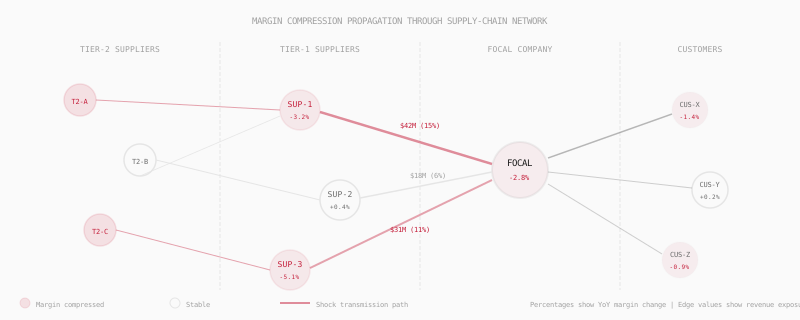
Recent research published by S&P Global Market Intelligence demonstrates that margin pressure does not remain isolated within individual firms. Instead, it spreads through supply-chain networks, transmitting shocks from suppliers to customers and onward through entire commercial ecosystems.
This analysis was enabled by Business Relationship Analytics (BRA), a dataset jointly developed by S&P Global Market Intelligence and RedGraphs, designed to model customer–supplier relationships as economically meaningful, machine-readable networks.
Why traditional analysis falls short
Most financial analysis treats companies as independent units, grouped by sector, region, or market capitalization. While useful, these lenses struggle to explain why firms with similar fundamentals can experience vastly different outcomes under the same macro conditions.
The missing dimension is interdependence.
Modern firms operate inside dense, global networks of suppliers, customers, and partners. Cost shocks — whether from tariffs, logistics, labor, or capital investment — propagate along these links. Ignoring those connections obscures second-order and third-order effects that increasingly dominate real-world outcomes.
Economic relationships as first-class primitives
Business Relationship Analytics (BRA) is built on a direct premise: economic relationships are primitives, not annotations.
Rather than merely identifying whether two companies are connected, BRA estimates the economic significance of each relationship — how much revenue or cost exposure flows through a given link. This transforms supply chains from static lists into weighted networks capable of supporting rigorous, quantitative analysis.
In the S&P research, these weighted networks made it possible to measure how the performance of suppliers and customers influenced firm-level margins and returns — not anecdotally, but across thousands of companies globally.
What the research shows
Using BRA-derived supply-chain networks, the study finds clear evidence of supply-chain contagion:
- Firms connected to outperforming suppliers and customers were materially less likely to experience margin compression.
- Firms tied to underperforming partners were significantly more likely to see margins contract.
- Supplier health proved more influential than customer demand, highlighting the asymmetric role of upstream dependencies.
- The magnitude of exposure mattered: concentrated relationships transmitted shocks more sharply than diversified ones.
These results reinforce a critical insight: resilience is a network property, not a firm-specific trait.
Why this matters
For investors, policymakers, and corporate strategists, the implications are profound:
- Risk is transmitted, not contained.
- Diversification must be evaluated at the network level.
- Trade and tariff policies create cascading effects that cannot be understood in isolation.
- Firm outcomes increasingly depend on who they are connected to — and how strongly.
As global supply chains become more complex and more fragmented, economic analysis must evolve from static classification toward dynamic relationship modeling.
The role of RedGraphs
RedGraphs provides the infrastructure required to build, validate, and analyze economic relationship networks at scale.
By transforming fragmented disclosures into resolved, weighted relationship graphs with full provenance, RedGraphs enables institutions to observe how money, risk, and dependency flow through the global economy — not as snapshots, but as evolving systems.
The S&P research illustrates what becomes possible when relationships are treated as foundational data, rather than supplementary context.
Looking ahead
This write-up is part of an ongoing series highlighting how relationship-level intelligence is reshaping economic and financial analysis. Future pieces will explore additional applications across investment research, supply-chain resilience, policy analysis, and corporate strategy.